
Week 2 Saturday — That First Easter... I Was There
Day 13: The Disciples at the Table

Day 13: The Disciples at the Table
Luke 22:14-27; John 13:3-5
Introduction
The bread had just been broken.
The cup had just been poured. Jesus had looked around the table at the men He had walked with for three years — men He had healed alongside, prayed with, taught in private, loved through every failure — and offered them His body and His blood. “Do this in remembrance of me.”
And then He told them that one of them would betray Him.
The room should have gone silent. It should have brought every one of them to their knees — searching their own hearts, examining their own loyalty, sitting in the weight of what He had just said. And for a moment, it did. “Lord, is it I?” they asked, one by one.
But the moment passed. And what followed is one of the most jarring sentences in all of Scripture:
“A dispute also arose among them as to which of them was considered to be greatest.”
Not grief. Not repentance. Not a sustained reckoning with their own capacity for betrayal. An argument. About rank. At the Last Supper. Minutes after Jesus had given them His body and blood.
We read that and shake our heads. And then we recognize ourselves in it completely.
Scripture
¹⁴ When the hour came, Jesus and his apostles reclined at the table. ¹⁵ And he said to them, “I have eagerly desired to eat this Passover with you before I suffer. ¹⁶ For I tell you, I will not eat it again until it finds fulfillment in the kingdom of God.”
¹⁷ After taking the cup, he gave thanks and said, “Take this and divide it among you. ¹⁸ For I tell you I will not drink again from the fruit of the vine until the kingdom of God comes.”
¹⁹ And he took bread, gave thanks and broke it, and gave it to them, saying, “This is my body given for you; do this in remembrance of me.” ²⁰ In the same way, after the supper he took the cup, saying, “This cup is the new covenant in my blood, which is poured out for you.”
²⁴ A dispute also arose among them as to which of them was considered to be greatest. ²⁵ Jesus said to them, “The kings of the Gentiles lord it over them; and those who exercise authority over them call themselves Benefactors. ²⁶ But you are not to be like that. Instead, the greatest among you should be like the youngest, and the one who rules like the one who serves. ²⁷ For who is greater, the one who is at the table or the one who serves? Is it not the one who is at the table? But I am among you as one who serves.”
— Luke 22:14-20, 24-27 (NIV)
³ Jesus knew that the Father had put all things under his power, and that he had come from God and was returning to God; ⁴ so he got up from the meal, took off his outer clothing, and wrapped a towel around his waist. ⁵ After that, he poured water into a basin and began to wash his disciples’ feet, drying them with the towel that was wrapped around him.
— John 13:3-5 (NIV)
Reflection
The Argument Nobody Should Have Had
Luke places the argument about greatness immediately after the institution of communion. The timing is not accidental — it’s devastating. Jesus has just offered them the most intimate, costly gift in history. And they pivoted to a favorite competition.
What were they arguing about exactly? Probably position in the coming kingdom. Who would sit closest to Jesus when He took His throne. Who had been most faithful, most effective, most deserving of the highest rank. It was the same argument they’d been having for months — the same one James and John’s mother had tried to settle by going directly to Jesus with a request for the best seats.
They weren’t bad men. They were ambitious men. Men who genuinely believed in Jesus and genuinely wanted to be near Him — but who couldn’t stop measuring themselves against each other long enough to understand that He was the standard of measurement.
They wanted the glory of the kingdom without understanding the cost of it.
Jesus didn’t respond with anger. He responded with a towel.
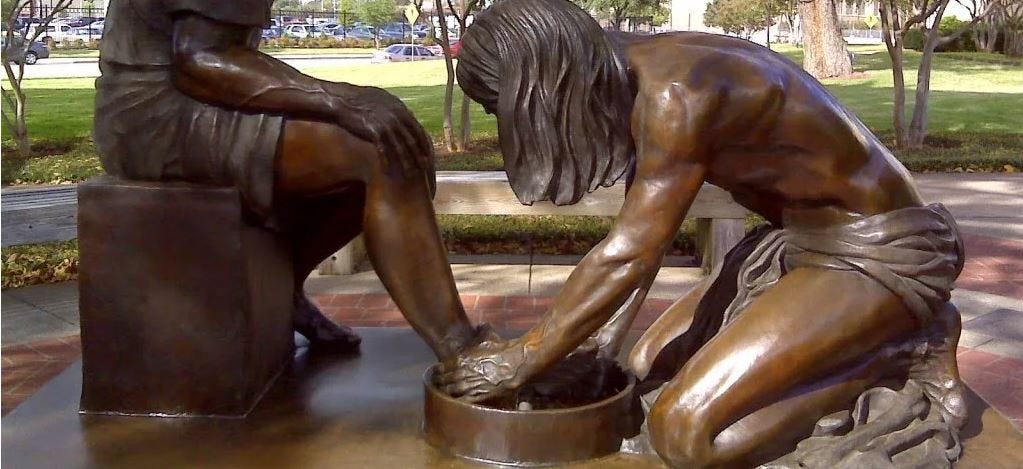
John tells us that Jesus — knowing that the Father had put all things under His power, knowing He had come from God and was returning to God — got up from the table, wrapped a towel around His waist, and began washing feet. The one with all authority took the position of the lowest servant. The King got on His knees in front of the men who had just been arguing about who among them deserved to be king.
He answered their pride with a basin of water. He met their argument with service.
We Are Like Them
The argument at the table didn’t end at the Last Supper. It’s been running ever since — in churches, in ministries, in families, in our own hearts.
Who is more important? Whose contribution matters more? Who deserves more recognition, more authority, more credit? We dress it up in spiritual language — we call it vision, or leadership, or having a higher calling — but underneath it is the same restless comparison the disciples couldn’t stop making.
We measure ourselves against the person in the next pew. Against the pastor with the bigger church. Against the writer with more readers, the volunteer who gets more appreciation, the leader whose name gets called first. We tell ourselves we just want to serve effectively — but we notice, quietly and persistently, where we rank.
And we do it at the table. Right after Jesus has given us everything. Right after we’ve been reminded of the body broken and the blood poured out — we walk out of communion and back into comparison.
Here’s what is stunning about Jesus in this moment: He didn’t address the competition directly. He didn’t rebuke their ambition or shame their rivalry. He went underneath it — beneath the surface argument to the heart driving it — and found something worth redeeming. A passion. A devotion. A hunger to matter, to be significant, to be close to the King. He didn’t extinguish that fire. He redirected it. Away from self-promotion and toward servanthood. Away from grasping for the highest seat and toward kneeling at the lowest place.
He didn’t rebuke their desire to be great. He redefined what greatness looks like in His kingdom.
And then He demonstrated it. On His knees. With a towel. Just hours before they would desert Him — knowing they wouldn’t fully understand it until later — He loved the heart beneath the competition and showed them a different way to be great.
That’s the grace that undoes the argument: the greatest person in the room got up and washed feet. Not to shame them. To show them the kingdom.
We were there at that table, measuring ourselves against each other while Jesus broke the bread. We are there now — in every moment we rank ourselves against someone else instead of kneeling beside them.
“But I am among you as one who serves." Luke 22:27 — This is The Way
Grace Note
“Do nothing out of selfish ambition or vain conceit. Rather, in humility value others above yourselves, not looking to your own interests but each of you to the interests of the others. In your relationships with one another, have the same mindset as Christ Jesus: who, being in very nature God, did not consider equality with God something to be used to his own advantage; rather, he made himself nothing.” — Philippians 2:3-7a (NIV)
Paul says the answer to the argument at the table is the mindset of Jesus — the One who had every right to the highest seat and chose the lowest position instead. He didn’t give up greatness. He redefined it. The same Jesus the disciples were competing to sit closest to got up and washed their feet — and in doing so, showed them what true greatness had always looked like. That’s not just an example to follow. That’s a grace to receive: the King already got on His knees for you. You don’t have to compete for His attention. You already have it.
Prayer Prompt
Jesus,
I confess that I carry the argument with me. The quiet comparisons. The measuring. The noticing where I rank and how I’m seen and whether my contribution is valued as much as someone else’s. I do it at the table — right after receiving everything You’ve given me, I walk back into competition.
Forgive me for the pride dressed up as ambition. For the self-promotion dressed up as vision. For the comparison dressed up as discernment. You redefined greatness and then demonstrated it on Your knees — and still I keep reaching for the highest seat.
Teach me the towel. Not as an act of self-abasement, but as a genuine reorientation — away from who is greatest and toward who needs to be served. You got up from the table for me. Help me get up from the table for others. And remind me, when the argument starts again, that the King of the universe already has His eyes on me. I don’t have to compete for a seat. You already gave me one. Amen.
Response
1. Name the Comparison: Who do you most consistently measure yourself against? A colleague, a sibling, someone in your church or community whose success or recognition quietly bothers you? Name them — not to confess envy to them, but to bring the specific comparison into the light. The argument at the table was never abstract. It was personal. So is ours.
2. Pick Up the Towel: Find one concrete way today to serve the person you most often compete with — or someone you’ve been ranking yourself above. Not to perform humility, but to practice it. Send an encouraging message. Speak well of them publicly. Do something for them that they’ll never know came from you. Let the act of serving interrupt the habit of comparing.
3. Receive Before You Give: Before you can genuinely serve from humility rather than obligation, you need to receive what Jesus has already done. Spend 5 minutes today sitting quietly with this image: Jesus, knowing He had all authority, wrapping a towel around His waist and kneeling in front of you. Not to shame you. To serve you. Let that land before you try to do anything with it.
To read all the posts in this devotional series, visit: That First Easter... I Was There
© Steve Peschke / This Is The Way