
The Storm Doesn’t Change Your Coordinates
Day 19 — Headwind: Acts 27:1-2, 20-25

Introduction
You’ve spent the last two days learning something hard: that the right response to weariness is not to grip harder, but to open your hands. To stand down. To trust the Captain with the heading when you no longer have the strength to fight for control of it.
That posture — surrender, release, trust — is exactly what you’ll need for what comes next.
Because this wind is different from every other one in this series. The earlier winds were things to endure — disappointment, fear, loss, weariness. This one is a navigational principle. It doesn’t just ask what you do with the difficulty. It asks what the difficulty might be telling you about where you are.
Sometimes resistance is a warning. A closed door is a closed door, and wisdom reads it correctly and adjusts. But sometimes — and this is what Paul’s voyage to Rome makes undeniable — the resistance is not a warning at all. It is a confirmation. The storm’s opinion of your destination has nothing to do with whether your destination is right.
Pay attention to where this one points.
Scripture
When it was decided that we would sail for Italy, Paul and some other prisoners were handed over to a centurion named Julius... We boarded a ship from Adramyttium. — Acts 27:1-2a (NIV)
When neither sun nor stars appeared for many days and the storm continued raging, we finally gave up all hope of being saved. After they had gone a long time without food, Paul stood up before them and said: “Men, you should have taken my advice not to sail from Crete; then you would have spared yourselves this damage and loss. But now I urge you to keep up your courage, because not one of you will be lost; only the ship will be destroyed. Last night an angel of the God to whom I belong and whom I serve stood beside me and said, ‘Do not be afraid, Paul. You must stand before Caesar; and God has given you the lives of all who sail with you.’ So keep up your courage, men, for I have faith in God that it will happen just as he told me.” — Acts 27:20-25 (NIV)
Reflection
What’s Happening in the Text
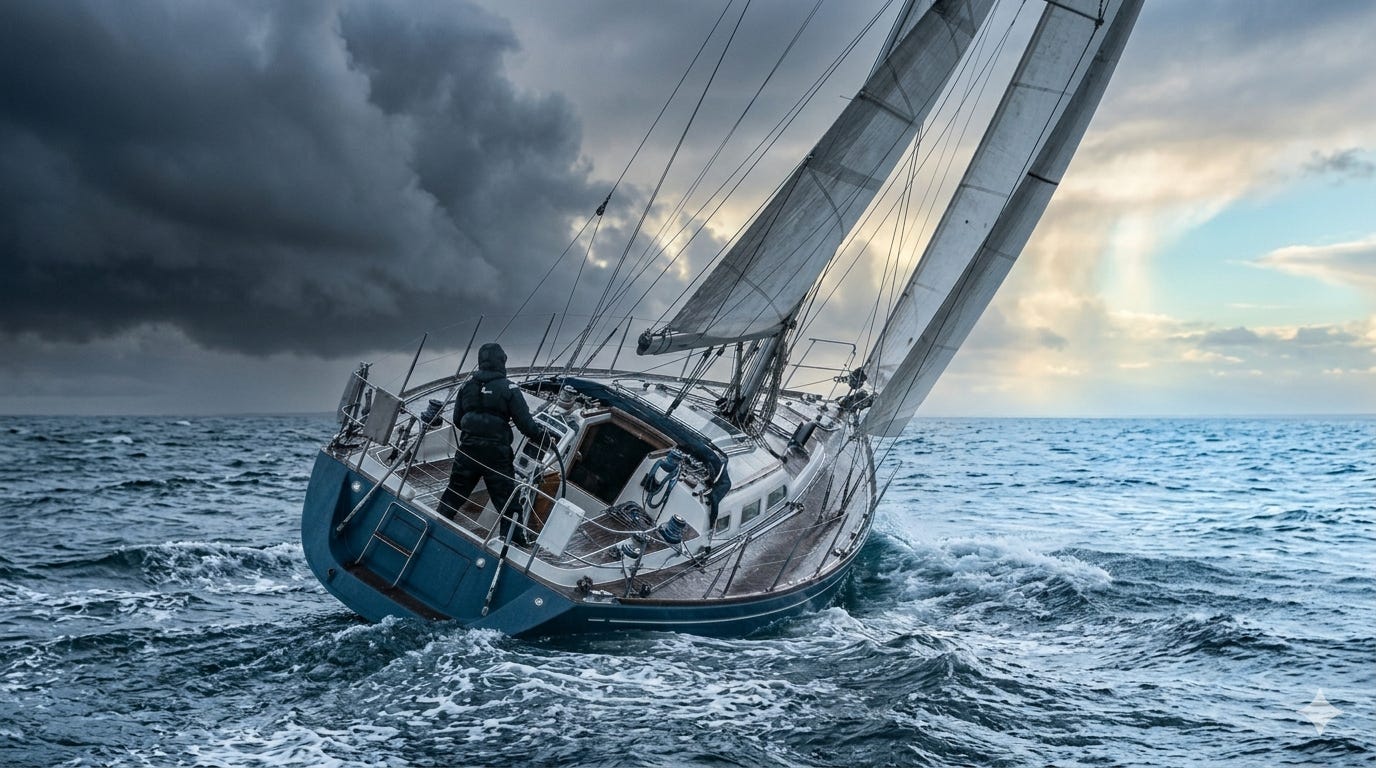
Paul is a prisoner on a ship in the middle of the Mediterranean in a storm so severe the text says they finally gave up all hope of being saved. The sun has been gone for days. The stars — the ancient navigator’s only fixed reference points — have disappeared. No one on board knows where they are.
And Paul stands up.
Not to panic. Not to demand answers. To deliver a word he received the night before from an angel who came to him in the dark of the storm: You must stand before Caesar. The destination hasn’t changed. The commission hasn’t been revoked. The storm’s opinion of the voyage is irrelevant to the voyage itself.
What’s remarkable is not just that Paul has faith — it’s the specific shape of his faith. He’s not trusting that the storm will stop. He’s trusting that the word is still good. Those are different things. The storm may continue. The ship will be lost. But every person on board will survive, because God has somewhere for Paul to be, and Paul is on this ship.
The resistance doesn’t change the coordinates. It confirms them.
What This Means for the Reader
Most of us have navigated by the stars — by the visible signs that we’re on course, the open doors, the provision that arrives, the confirmation that what we’re doing is right. When those signs disappear and the storm rises, we lose our reference points. And without reference points, resistance starts to look like redirection.
But Paul’s calm in Acts 27 is the calm of a man who has a word that doesn’t depend on the weather. He received a commission before the voyage began — you will stand before Caesar — and the storm’s intensity doesn’t revise that word. If anything, the violence of the resistance is evidence of the significance of the destination. You don’t encounter this kind of opposition going nowhere.
Here is the principle: heavy resistance in a direction you’ve been clearly called toward is not automatically a sign to stop. It may be a sign that you’re close to something that matters. The adversary doesn’t waste his ammunition on inconsequential trajectories. You don’t attack something that isn’t a threat. The storm pushes hardest against the ship that’s actually going somewhere.
This doesn’t mean every hard thing is confirmation that you’re on course. Wisdom still has a role. Counsel still matters. But when you have a word — a clear, tested, confirmed sense of where God has called you — the storm’s arrival is not sufficient reason to abandon the heading. Paul didn’t revise his destination when the weather turned. He held the word, and the word held him.
And notice what holding the word looked like: he stood up. In front of everyone. In the middle of the worst storm of the voyage. Not with bravado — with the steady confidence of a man who knows who sent him and where he’s going. The open hands of surrender from yesterday and the steady stance of today are not in contradiction. You release control to the Captain precisely so He can hold the heading you cannot.
The resistance you’re facing may not be a sign to stop. It may be a sign that you’re getting close.
Grace Note
“Being confident of this, that he who began a good work in you will carry it on to completion until the day of Christ Jesus.” — Philippians 1:6 (NIV)
Paul wrote this from prison. The man who stood on the storm-tossed deck and said keep up your courage wrote about confidence in completion while under house arrest. He wasn’t writing from the other side of the storm. He was writing from inside it — certain not of the weather, but of the One who set the heading. The good work doesn’t stop when the wind rises. It continues — carried by the same hands that began it.
Prayer Prompt
Father, I want to be honest about the resistance. It’s been loud. And somewhere along the way I started letting it speak — letting it tell me things about the direction I’ve been moving, about whether the word I thought I had was real, about whether I’m the kind of person You actually call and keep. The storm has had more of my attention than the commission.
I’m not sure I have Paul’s clarity right now. I don’t know that I can stand up in front of the people around me and say keep up your courage when I’m the one who needs to hear it. But I know You spoke. I know there was a word, a call, a sense of direction that didn’t come from me. And I know the storm’s arrival doesn’t revise what You said.
I practiced opening my hands yesterday. Today I’m asking for something harder — the courage to stay standing in the storm with open hands. Not gripping the outcome. Not fighting for control of the heading. But not sitting down either. Standing. Trusting that the word You gave me is still good, that the destination hasn’t changed, and that the resistance pressing hardest against me may be the clearest sign yet that I’m going somewhere that matters.
You got Paul to Rome. You’ll get me where You’re taking me. Amen.
Response
1. Write the Word (Written Reflection): Take a few minutes and write down the clearest sense of calling or direction you carry — the thing you believe God has spoken over your life or your current season, however you received it. Not what you hope, not what you’ve inferred — the word, as best you can name it. Then underneath it, write the resistance you’re currently facing. Look at both on the page together. Which one came first?
2. Read It as Paul (Verbal): Read Acts 27:22-25 aloud, slowly, as if you are Paul speaking to the crew. Feel the weight of standing up in a storm and delivering a word that depends entirely on the character of God. When you finish, sit with this question: What would it look like to hold my word the way Paul held his?
3. Look for the Pattern (Observational): Today, pay attention to where the resistance in your life is concentrated. Not to catalogue your difficulties — but to notice direction. Heavy opposition tends to cluster around things that matter. Where is it loudest? What is it pushing against? Let that be a question you carry through the day, not one you have to answer by tonight.
To read all the posts in this devotional series, visit: https://www.thisistheway.live/t/headwind
© Steve Peschke / This Is The Way