
The Messiah Code
How Jesus Unlocked Everything

How Jesus Unlocked Everything
There is a moment in Luke 24 that I keep returning to. Two disciples are walking away from Jerusalem — seven miles to Emmaus — rehearsing the wreckage of everything they had hoped for. The man they believed was the Messiah is dead and buried. The tomb is empty, but that only adds confusion to the grief. So they walk. Heads down. Talking it through.
A stranger falls into step beside them.
He listens. He asks questions. And then, somewhere on that dusty road, He begins to teach. Starting with Moses, moving through the Prophets, He traces a single thread through the entire sweep of Israel’s Scripture — and shows them how every line, every promise, every shadow, every sacrifice was pointing toward one place. Toward one Person.
They don’t recognize Him. Not yet. But something is happening inside them that they can’t name. A warmth. A burn. A sense that something long-sealed is being opened.
Later, after He breaks bread and their eyes finally open, they turn to each other and ask the question that I believe sits at the heart of the entire Christian life: “Did not our hearts burn within us while he talked to us on the road, while he opened to us the Scriptures?”
That burning is what I want to talk about. Because I don’t think it was unique to that road. I think it is available to everyone who has ever opened the Old Testament and felt the strange, nagging sense that they were reading something vast — something written from a distance, pointing toward something just out of view.
Jesus is the key that unlocks it all. This is what I’ve come to call the Messiah Code.
What They Were Carrying
To feel the full weight of that Emmaus conversation, you have to understand what those two disciples brought to it.
They were not scripturally illiterate. Far from it. First-century Jewish men and women inhabited the Scripture in a way that is almost foreign to modern Western Christians. They didn’t just read the Torah — they memorized it. Large portions of the Psalms, the Prophets, and the Law were committed to memory from childhood. These weren’t academic texts. They were the atmosphere of their homes, the rhythm of their calendar, the architecture of their worship.
They knew the festivals — Passover, Pentecost, Tabernacles — not as historical commemorations but as living reenactments of God’s faithfulness. They prayed the Psalms. They celebrated the sacrificial system. They studied the Law. They carried the weight of four hundred years of prophetic silence and the long, burning hope that one day — one day — the Messiah would come.
They were not walking away from Jerusalem as people who had never read the Bible. They were walking away as people who had read it their entire lives and still couldn’t make sense of what had just happened.
That is the condition of many sincere believers today. We come to faith. We receive the Gospel. And then we open the Old Testament — with its genealogies and dietary laws and tribal warfare and temple measurements — and quietly wonder what any of it has to do with us. Or with Jesus. It feels like a foreign country. Connected, perhaps, but not unlocked.
The disciples on the road to Emmaus felt that. They had the map but couldn’t read it. They had the key in their hands but didn’t know which door it opened.
The Day the Code Broke Open
Jesus announced His interpretive intention early.
In Luke 4, He enters the synagogue in Nazareth — His hometown — on the Sabbath. He stands to read and is handed the scroll of Isaiah. He unrolls it to chapter 61 and reads:
“The Spirit of the Lord is upon me, because he has anointed me to proclaim good news to the poor. He has sent me to proclaim liberty to the captives and recovering of sight to the blind, to set at liberty those who are oppressed, to proclaim the year of the Lord’s favor.”
He rolls up the scroll. He hands it back to the attendant. He sits down. (I find this quietly stunning. He simply sits down.) Every eye in the synagogue is fixed on Him.
And then He declares seven words that change everything: “Today this Scripture has been fulfilled in your hearing.”
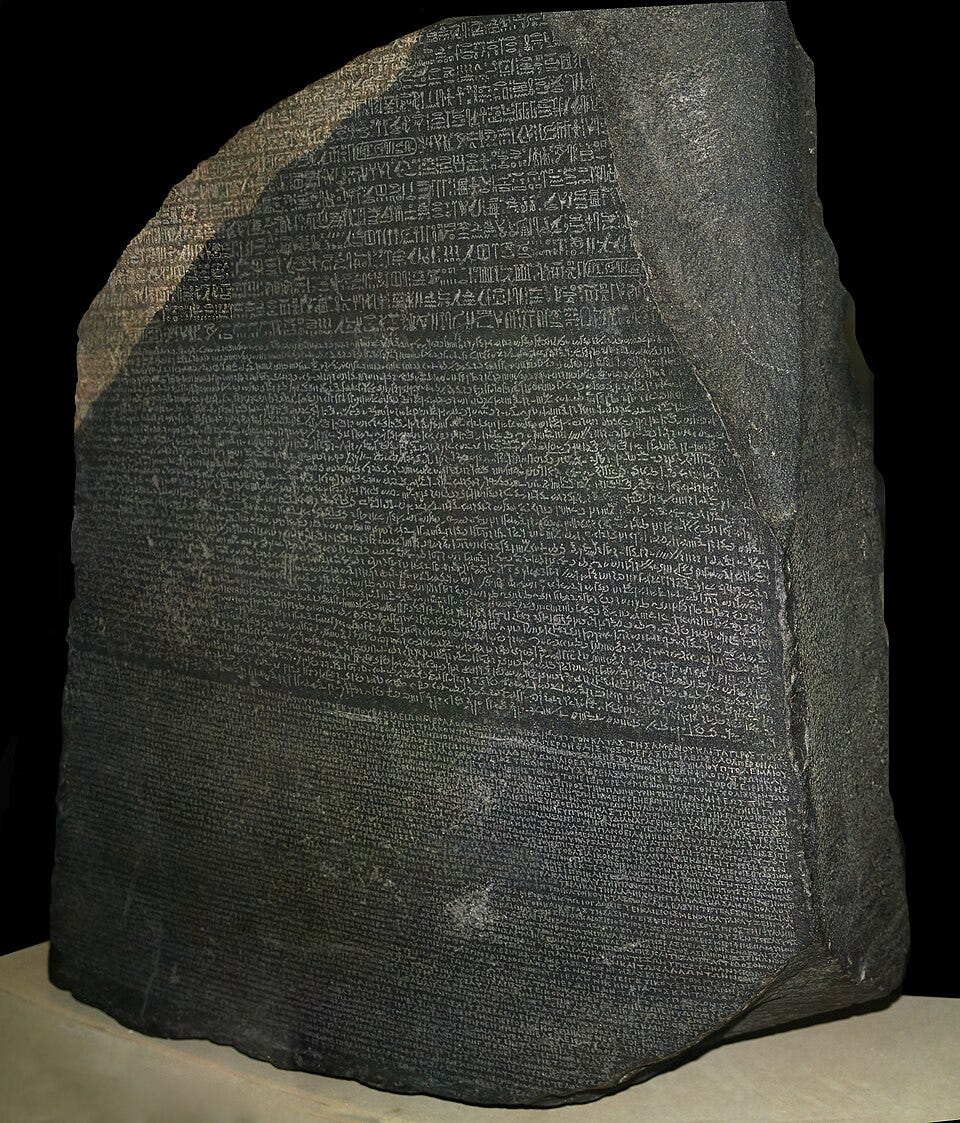
Luke 4:21 is not a footnote. It is the Rosetta Stone of the entire Old Testament. Jesus is not claiming to admire Isaiah or to be inspired by Isaiah. He is claiming to be what Isaiah was pointing at. He is announcing that the long wait is over. The prophecies are not still pending — they are present tense. Today. In your hearing. In this room. Standing in front of you.
The response in the synagogue is remarkable in its speed. First, amazement: “All spoke well of him and marveled at the gracious words that were coming from his mouth.” Then, almost immediately, fury. “And they rose up and drove him out of the town and brought him to the brow of the hill on which their town was built, so that they could throw him down the cliff.”
The same words. The same room. Amazement and murderous rage. Why?
Because Jesus was introducing a new frame — and a new frame always creates a division. Not the old division of Jew and Gentile. Not clean and unclean. Something more fundamental: those who recognized what was being unlocked and those who refused it. Sighted and blind. Hearing and deaf. Those whose old framework shattered open into something larger, and those whose framework simply shattered.
He told them it would be this way. “Do not think that I have come to bring peace to the earth. I have not come to bring peace, but a sword. For I have come to set a man against his father...” The Messiah Code, once spoken aloud, forces a choice that no one can avoid by staying in the middle.
A Teacher Unlike Any Other
But here is what made Jesus’s unlocking different from mere reinterpretation. Every rabbi interpreted Scripture. Every scribe taught the Law. The Pharisees were meticulous students of the text, and the teachers of the Law spent their lives parsing its meaning.
Jesus taught differently. Matthew records the crowd’s reaction after the Sermon on the Mount: “And when Jesus finished these sayings, the crowds were astonished at his teaching, for he was teaching them as one who had authority, and not as their scribes.”
The scribes taught by precedent and appeal. “Rabbi So-and-so said this, and Rabbi Such-and-such said that.” Authority was borrowed and attributed. But Jesus taught with a directness that had no precedent: “You have heard that it was said... but I say to you.” Not correcting Moses — fulfilling him. Going underneath the letter of the Law to the intention behind it. Not abolishing but completing.
And His teaching was not merely cognitive. He did not transfer information — He performed transformation. His words came attended by signs: the blind received sight, the lame walked, the dead were raised. When He told the paralyzed man that his sins were forgiven, He immediately healed him — not to show off, but to demonstrate that what He was saying was real in every dimension. The teaching and the reality behind the teaching were inseparable.
This is why the Emmaus disciples’ hearts burned. They weren’t merely receiving a more sophisticated biblical lecture. They were in the presence of the One the lecture was always about. The Author was walking them through His own book. Of course something was set on fire.
What the Code Unlocks
Once you have this key in hand, the Old Testament becomes a different book.
The sacrificial system is no longer a strange ancient ritual — it is the long, patient preparation of a people to understand what it would mean for a spotless lamb to die in their place. Every Passover, every Day of Atonement, every grain offering and sin offering was rehearsal. The whole nation was being taught, over centuries, the grammar of substitution — so that when the Lamb of God appeared, those with ears to hear would recognize the language.
The Psalms become something more than Israel’s hymnbook. They become a window into the interior life of the Messiah Himself. Psalm 22 opens with a cry that Jesus spoke from the cross: “My God, my God, why have you forsaken me?” It describes details of crucifixion — the piercing of hands and feet, the casting of lots for clothing — centuries before crucifixion existed as a form of execution. The Psalmist was writing from inside an experience he couldn’t fully understand, pointing toward a moment he would never live to see.
The temple is no longer a religious building. It is a shadow of the One who would say “Destroy this temple, and in three days I will raise it up” — speaking of His body. Every piece of temple architecture, every veil and curtain and mercy seat, was a picture waiting for its original.
The festivals are not merely calendar events. Passover, Firstfruits, Pentecost — each one is a prophetic marker that Jesus fulfilled with extraordinary precision. He was crucified on Passover. He rose on the Feast of Firstfruits. The Holy Spirit descended on Pentecost. The festivals weren’t just commemorating the past. They were previewing the future, hiding in plain sight.
This is what I think lit the early church on fire. They didn’t have the New Testament — they had the Old. And now, with the Resurrection as the lens, it was reading like a completely different book. Peter’s sermon at Pentecost is essentially a Messiah Code lecture — Joel, the Psalms, the Davidic covenant, all of it snapping into focus around Jesus crucified and risen. “This Jesus, delivered up according to the definite plan and foreknowledge of God.” Not an accident. Not a tragedy. The culmination of a plan hidden in plain sight across centuries.
And then there is Stephen. When he stood before the Sanhedrin on trial for his life, he didn’t mount a legal defense — he preached the Messiah Code. From Abraham to Joseph to Moses to the tabernacle to Solomon’s temple, he walked the highest court in Israel through their own Scripture and showed them how every thread ran straight to Jesus. His face, Luke tells us, was like the face of an angel. He wasn’t reciting history. He was seeing clearly — perhaps more clearly than he ever had. They stopped their ears and rushed at him. And as the stones fell, he looked up and saw the Son of Man standing at the right hand of God.
Stephen didn’t die for a doctrine. He died because the code had broken so completely open in him that he could not stop saying what he saw. He was the first. He would not be the last. That is what an unlocked Scripture does to a person.
The Fruit of Unlocked Scripture
This is why Acts 2:42 looks the way it does.
“And they devoted themselves to the apostles’ teaching and the fellowship, to the breaking of bread and the prayers.”
Four things. Teaching. Fellowship. Breaking of bread. Prayers. These are not four programs that the early church happened to prioritize. They are the natural overflow of people whose entire reading of reality has been reorganized around a living Messiah.
The teaching — because there was suddenly everything to understand. Every scroll in every synagogue was now a treasure chest waiting to be opened, and the apostles held the key.
The fellowship — because the new frame had dissolved the old divisions. Jew and Greek, slave and free, male and female — all one in Christ Jesus. The love that the outside world found inexplicable was the direct fruit of a community that had seen themselves in the same story, redeemed by the same blood, made members of the same body.
The breaking of bread — because every meal now carried the memory of the Upper Room, and the Emmaus moment when broken bread opened their eyes. The table was a continuing act of recognition.
The prayers — because they were no longer praying toward an uncertain future. They were praying from inside a story whose ending they had already seen.
Francis Schaeffer called the love of the early Christian community “the final apologetic.” Tertullian recorded the pagans watching from the outside and saying: “Behold, how these Christians love each other!” But that love didn’t come from a self-improvement program. It came from the burning. From people who had walked the Emmaus road and come back changed.
The Messiah Code didn’t just unlock the Old Testament. It unlocked them.
The Key Is Still in Your Hands
I am Cleopas on that road. I suspect you may be too.
I came to faith carrying a Bible I only half understood. The New Testament felt alive and immediate. The Old Testament felt ancient and foreign — connected, I was told, but the connection wasn’t always visible to me. I read the genealogies and the Levitical codes and the minor prophets and wondered, honestly, what I was supposed to do with any of it.
And then, slowly, through teachers and through seasons in the Word and through what I can only describe as a burning that I didn’t always recognize in the moment — the code began to break open. A passage in Isaiah that I had read a dozen times suddenly read like a headline. A Psalm I had recited by rote suddenly sounded like a voice from the cross. A festival I had only understood historically suddenly felt like a calendar God had been keeping all along — pointing toward a day that had already come — and another day yet to come.
“Did not our hearts burn within us while he talked to us on the road?”
The same Jesus who walked with those two disciples through Moses and the Prophets walks with us through every page. That is not metaphor. The Helper He promised — the One who would teach us all things and bring to remembrance everything He said — is the same Spirit who inspired every word of the Old Testament to begin with. When you open that book and ask Him to open it to you, you are not alone on the road.
The code is not locked away for scholars and theologians. It is hidden in plain sight, waiting to be read by anyone willing to see Jesus on every page.
So here is my invitation to you, as someone who has walked this road: don’t let the Old Testament remain a foreign country. Don’t settle for a faith that begins at Matthew 1. Go back further. Go to the beginning. And read it asking one question: where is Jesus in this?
You will find Him everywhere. In the ram caught in the thicket on Mount Moriah. In the Passover lamb whose blood marked the doorposts. In the bronze serpent lifted up in the wilderness. In the prophet who said “he was pierced for our transgressions.” In the Psalm that begins in desolation and ends in the declaration that “he has not despised or scorned the suffering of the afflicted one; he has not hidden his face from him but has listened to his cry for help.”
He is there. He has always been there. And when you find Him — when the code breaks open and the whole story snaps into focus — your heart will burn.
That burning is the point.
I’m still on that road too. Maybe we can walk together. Subscribe below and join me.
For Reflection
Before you close this page, sit with one of these:
Is the Old Testament a foreign country to you? What would it mean to begin reading it as one long story pointing toward Jesus?
Has there been a moment — a passage, a season, a conversation — where the code broke open for you, even partially? What did that feel like? What changed?
The Emmaus disciples only recognized the burning after the fact. Looking back over your own journey of faith, where do you think Jesus may have been walking with you and opening the Scriptures — even when you didn’t recognize Him in the moment?
The Emmaus road passage in Luke 24 is explored in more depth in an accompanying devotional — “Did Not Our Hearts Burn?” — which you can read
by clicking this link.