
That The World May Know
John 13. John 17. The same night. The same answer.

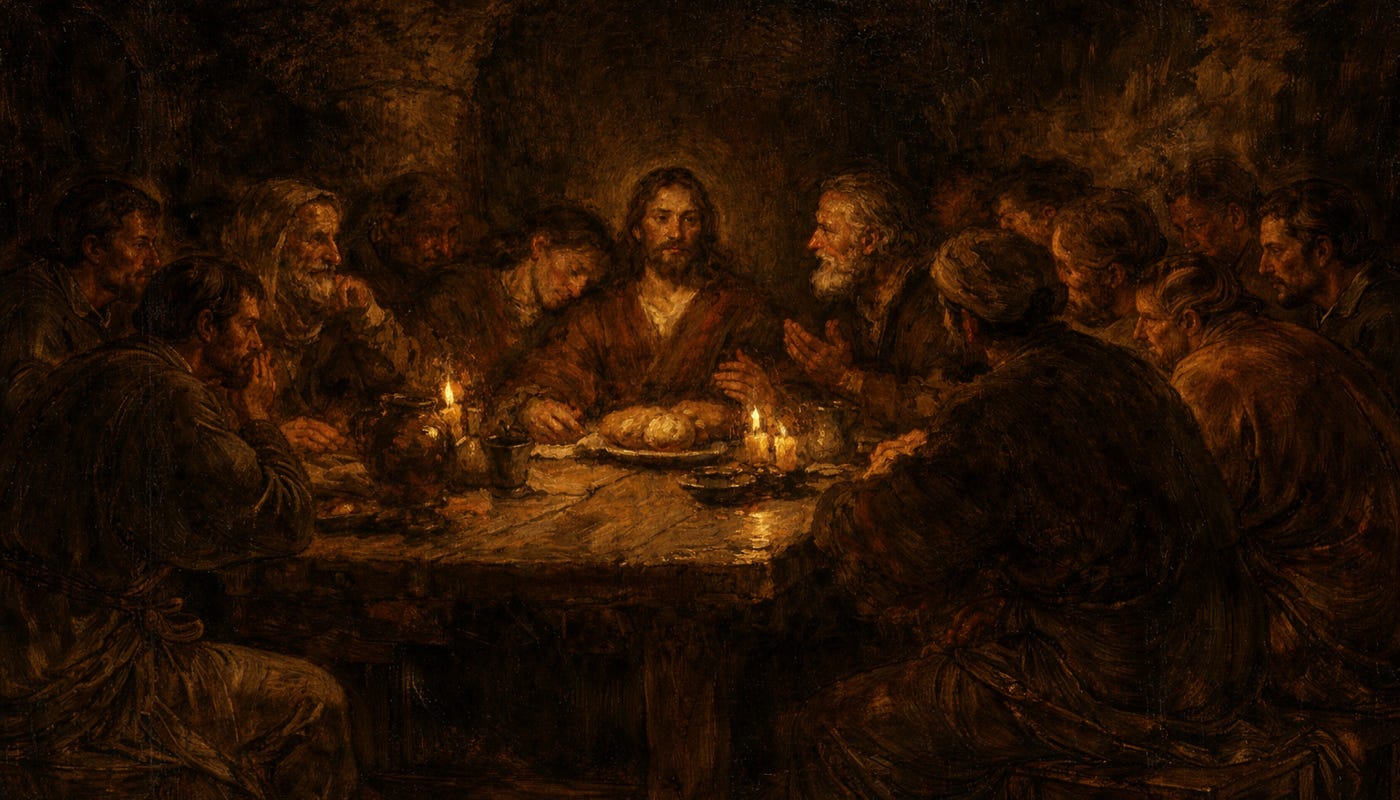
The Gospel of Jesus is beyond countercultural. It’s not human. It’s other-worldly.
On the night of His betrayal, with Judas already gone and the machinery of His arrest already in motion, Jesus turned to the disciples who remained and made two startling declarations. He wasn’t talking only to the eleven men around that table — He was speaking to everyone who would ever call Him Lord. He identified two marks that would distinguish His followers. Two things that would make the world stop and take notice. Two proofs, really, of His identity and the reality of God’s love. They’re bookends from the same night, the same conversation, the same burdened heart.
What He said next should unsettle us — and inspire us.
The First Mark: Love That the World Can’t Explain
The first declaration came in the context of a new commandment. John 13:34-35 —
“A new commandment I give to you, that you love one another: just as I have loved you, you also are to love one another. By this all people will know that you are my disciples, if you have love for one another.”
Notice what Jesus did just before He said this. He washed their feet. And within hours, He would go to a cross. He wasn’t talking about a warm feeling or a comfortable affection. He was describing a love calibrated to sacrifice — His own sacrifice as the standard.
This kind of love is not only shocking in its depth, it’s distinctive in its reach. Jesus said a loving community of Christ followers is the visible authentication of the Gospel. The theologian Francis Schaeffer called it “the final apologetic.” Not our arguments. Not our programs. Our love.
Unlike almost every other human association — which forms around shared ethnicity, age, political opinion, economic status, or background — the church is to be marked by a radical inclusiveness that echoes the acceptance of Jesus Himself. We are to welcome all people, regardless of where they come from, what they’ve done, or how different they are from us. That kind of community doesn’t happen naturally. It’s supernatural.
Tertullian, writing in the late second century, recorded something remarkable. The pagans around the early church were saying: “Behold, how these Christians love each other! How ready they are to die for each other!” Their mutual love was a magnet. It drew people toward Christ before they could articulate a theology of Christ.
It still works that way. In today’s fragmented, suspicious culture, many people will be drawn to the love of God’s people long before they can accept the love of God Himself. What an opportunity. What a responsibility.
May we be a community that genuinely loves — across all our differences. Always searching for ways to join our voices in proclaiming the Gospel. Always ready to affirm Christlikeness wherever we find it. Always willing to link arms in the Mission of God and set aside the things that divide us. Always cultivating the love of Christ that unites us under His Lordship.
The Second Mark: Unity That the World Can’t Manufacture
The second declaration came hours later, in what John records as the High Priestly Prayer of Jesus in John 17. It’s one of the most intimate passages in all of Scripture — a window into the relationship between Father and Son at the most critical moment in human history.
In verses 20-22, Jesus does something remarkable. He prays for us — not just the disciples in the room, but all who would believe through their testimony:
“I do not ask for these only, but also for those who will believe in me through their word, that they may all be one, just as you, Father, are in me, and I in you, that they also may be in us, so that the world may believe that you have sent me.”
Think about that. Hours before His arrest. Minutes before the garden. And what is burdening the heart of Jesus? Our unity.
He didn’t pray for our protection from hardship. He didn’t pray for power or victory or influence. He prayed that we would be one. And He didn’t set a modest goal — He pointed to the relationship within the Godhead itself as the model. Father, Son, and Holy Spirit: perfectly known to one another, secure in oneness of vision and mission, bound together by love and mutual submission. He prayed for nothing less than that fullness to be realized among His followers.
I’ll be honest — I can barely imagine that kind of unity with the one person on earth who knows me best. And yet that’s the prayer.
Jesus then ties this unity directly to mission. In verse 23, the purpose becomes clear: “that they may become perfectly one, so that the world may know that you sent me and loved them even as you loved me.”
There it is. Like the love in John 13, the unity of the Church is meant to be a compelling witness to the unbelieving world — evidence of the truth of the Gospel, the identity of Christ, and the love of the Father. Unity is not just good for us. It’s part of how the world comes to know Him.
Two Marks. One Mission.
I love how Jesus cuts through all the pretense and wisdom of men and goes straight to the heart of the matter. When the Pharisees came to Him with their theological puzzles, He reduced all the law and the prophets to two clear, devastating statements: love God with everything you are, and love your neighbor as yourself.
There is no shortage of writing about the purpose and mission of the Church. But Jesus, with stunning simplicity, reminds us that what matters most is not what we say about ourselves — it’s how we are known.
His half-brother James said it plainly: faith without works is dead. And Jesus said that we would be known to the world as His disciples by two simple, unworldly, costly things: love for one another and unity with one another.
Not our doctrine statements. Not our attendance numbers. Not our programs or platforms.
Our love. Our unity.
That the world may know.— This Is The Way
My prayer — As a Kingdom community, may we always protect the bonds of peace, continually seek common ground and purpose, and constantly look to forge alliances with other missional folks. May we always be ready to link arms with co-laborers in the harvest, encourage and uphold Christ followers throughout the world, and never fail to celebrate the advance of the Kingdom. May we be known by the love of Christ and the unity of His Spirit. That the world may know. Amen!